
Sequatchie County Parole vs Probation
Tennessee separates the body that makes a parole decision from the agency that supervises the person. The Tennessee Board of Parole decides discretionary parole. TDOC Community Supervision oversees both parolees and probationers. Parole is conditional release before a state sentence expires. It requires a Board grant and an approved release plan. Probation is a court-ordered community sentence or, in some short felony cases, the result of Tennessee's determinate-release law.
| Point | Parole | Probation |
|---|---|---|
| Starting authority | Board grant plus TDOC plan approval | Court order or determinate-release process |
| Custody meaning | Out of prison, sentence still active | In the community under a court sentence |
| Supervisor | TDOC Community Supervision | TDOC Community Supervision when assigned |
| Verification | FOIL, office, Board record | FOIL, judgment, office |
| End point | Expiration or official discharge | Completion or official discharge |
Both statuses mean physical state incarceration has ended for that custody layer while legal duties continue. Neither status should be inferred from a disappearance from the Sequatchie County Justice Center. The county release record may say probation, commitment, or transfer. FOIL and the judgment then explain the state supervision chain.
- Parole
- Conditional community release from a state sentence after Board action and plan approval.
- Probation
- A community sentence ordered by a court or reached through statutory determinate release.
- Discharge
- The official end of a supervision obligation.
- Absconder
- A person alleged to have stopped reporting or complying with supervision.
Verify Sequatchie County Supervision
The official online starting point is TDOC FOIL. It covers current and former Tennessee felony custody or supervision. Search by exact TOMIS or TDOC ID when possible. Name searches also use last name, first name, race, and aliases. A CAPTCHA protects the form. FOIL does not cover every local misdemeanor, pretrial booking, or out-of-state supervision case.
- Search the exact TOMIS or TDOC number, or use carefully matched identity fields.
- Open the match and compare its identifier before relying on status.
- Read status and location together. Parole or probation with a community office supports active supervision.
- Compare the result with the sentencing judgment or parole record.
- Use the TDOC office directory to confirm assignment.
- Call the listed office if the current assignment or discharge is unclear.
- Request the official discharge record when exact proof is needed.
A FOIL status of parole or probation supports release from physical state incarceration, not release from all legal duties. Inactive means a former or inactive TDOC record, but the agency does not define that one label as successful discharge in every case. Check the sentence and release details or obtain the archive. The Sequatchie County release-record route is better for a county booking that never entered the TDOC felony chain, especially because the sheriff domain publishes no verified release feed.
Note: Match FOIL status with its location because a community office and a prison describe very different custody states.
Sequatchie County District 30 Office
Sequatchie County is assigned to TDOC Community Supervision District 30. The directory block serving Bledsoe, Hamilton, Marion, Rhea, and Sequatchie identifies the Chattanooga office. A separate District 30 suboffice in Jasper may look closer, but TDOC labels that location for Grundy and Marion. Geography alone does not control the assignment.
3602 Elwood Lane
Chattanooga, TN 37416
Phone: (423) 634-6333
Fax: (423) 634-6364
Verify the current assignment in FOIL and the directory before travel. Individual cases may move, and the listed office may route an inquiry. TDOC announced mobile community-supervision offices for rural access in 2026, but no verified Sequatchie County stop or timetable was found. A regional announcement is not a promise of local service.
Which Office Serves Sequatchie Supervision
The Chattanooga assignment is a distinctive local detail. Searchers may be tempted to call Jasper because it appears nearer to Sequatchie County. The current TDOC directory does not list Sequatchie under that suboffice. It lists the county within the Elwood Lane service block instead.
This office distinction affects the record path. The correct office can confirm whether FOIL still reflects active parole or probation, route a request for an official discharge record, and identify the record holder. It should not be asked to reinterpret a jail release. Sequatchie County Justice Center controls its booking end, while TDOC controls the state supervision record.
The official TDOC field-office directory shows the local assignment.
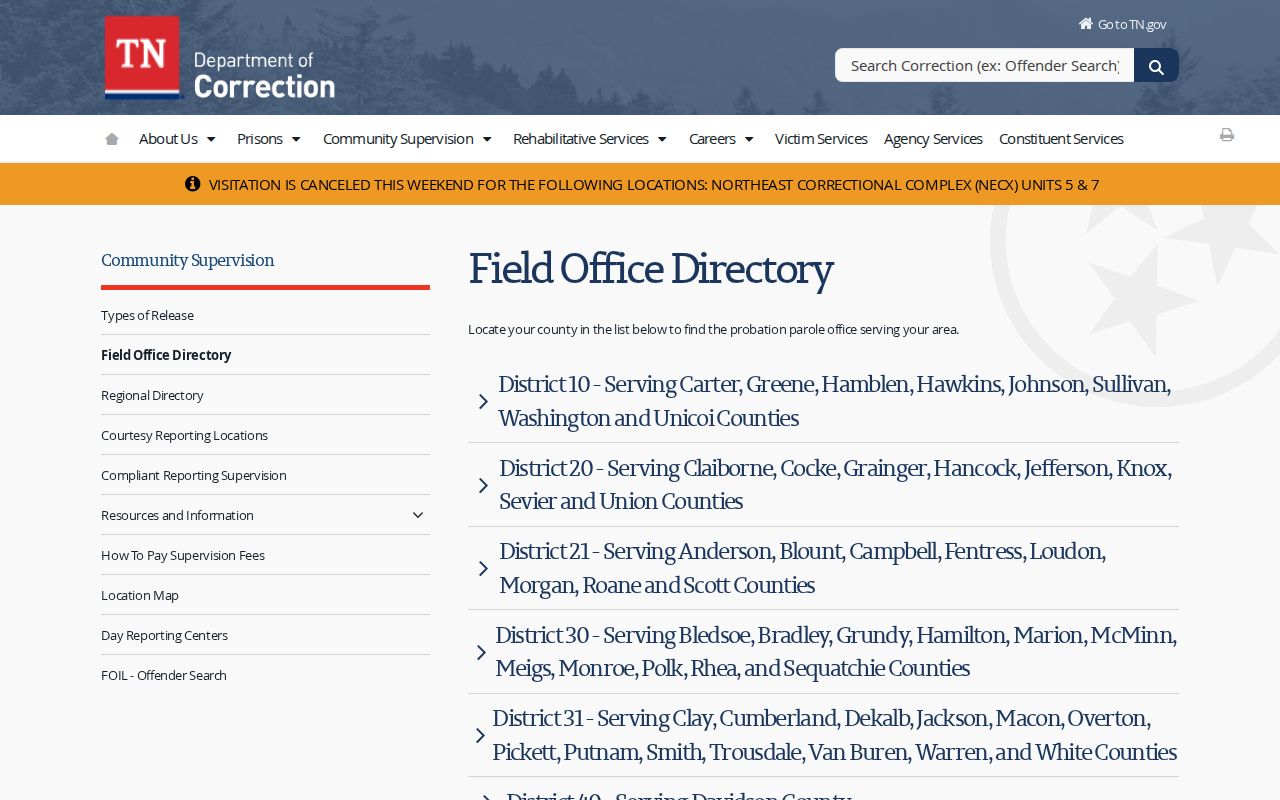
The captured county list and Chattanooga contact distinguish the verified assignment from the separate Jasper suboffice.
Sequatchie County Parole Hearings
The Tennessee Board of Parole hearing hub publishes separate schedules for county jails and state prisons. The Board says schedules update weekly on Monday, or Tuesday after a Monday holiday. Entries can show institution, TOMIS number, name, hearing type, and date. Sequatchie appears in the county-jail schedule index, but an empty period means only that no hearing is listed in that publication window.
A hearing date is not a release date. Initial and review grant hearings consider parole. Revocation hearings address alleged noncompliance. A custodial hearing considers parole from one sentence to another and is not community release. Pre-parole rescission can cancel a grant before exit. Hearing officers make recommendations, while Board members issue the decision. Even a grant does not produce release until TDOC approves the plan.
No separate public statewide results database was verified. FOIL may show an individual hearing status, and the Board explains decisions and appeals, but a final decision may require direct Board contact or a records request. The sequence is TDOC certification of the Release Eligibility Date, schedule, hearing, decision, plan approval, physical release, then FOIL parole status.
The published schedule and the final decision serve different purposes. Schedule entries can identify the institution, TOMIS number, person, hearing type, and date, but the Board warns that dates may change. Verify a listed hearing at (615) 741-1150 before relying on it. Older official guidance also gives BD.HearingSchedules@tn.gov as a route for schedules. When no current Sequatchie entry appears, that means only that the publication window contains no listed hearing. It does not prove that no Sequatchie-connected person is eligible or that an earlier case ended.
An appeal also does not reopen the case as a new merits hearing. The Board describes limited grounds such as significant new information, official misconduct, or a significant procedural error, and it generally requires the request within 45 days after the offender receives the final decision. Tenn. Code Ann. § 40-28-505 separately requires specified notices of grant hearings, final decisions, and parole releases to named justice officials and victims who requested notice. Those notices, the Board file, FOIL status, and the later discharge record provide a more complete Sequatchie County supervision history than a schedule alone.
Sequatchie Supervision Violations and Absconders
Conditions depend on the judgment, parole certificate, and supervision plan. They may include reporting, approved residence, travel limits, programs, or other case-specific duties. FOIL does not expose every condition, and a status should not be used to infer conduct. Obtain the controlling document or speak with the supervising office about an authorized personal or court matter.
An absconder is someone alleged to have stopped reporting or complying. It is not a new release type, a finding of guilt, or proof of a new conviction. No official Sequatchie County warrant or absconder list was verified. Check FOIL, the supervising office, the local court record, and authorized law-enforcement channels. VINELink can send certain custody changes, but it is not a probation-condition database.
Out-of-state cases need another check. FOIL help points to the TBI Out-of-State Parole and Probation Supervision Registry. A person supervised in Tennessee for a sentence from another state may not appear like an ordinary Tennessee sentence. Identify the sending state and interstate compact authority before treating a FOIL no-result as discharge.
Note: Alleged absconder status requires official confirmation and must not be inferred from missed contact, rumor, or a search no-result.
How Sequatchie County Supervision Ends
Supervision ends through its governing sentence and an official closing action, not merely when a person stops appearing in a jail search. For parole, sentence expiration or an authorized discharge closes the active state supervision relationship. For probation, completion or a court or TDOC discharge controls. Revocation can instead return the matter to custody or further proceedings.
If FOIL still shows parole or probation after the expected end, confirm the identity, observation date, sentence, and office. Ask District 30 whether the assignment remains active. For documentary proof, request supervision start and end dates, the discharge record, and related sentence material from TDOC Records Management. Archived-record questions can be directed to (615) 253-8079.
Public-record access remains subject to confidentiality, safety, sealed-record, and expungement limits. A request should name the existing record and allow the custodian to cite any legal basis for withholding. The Board, court, TDOC, and county jail each hold different parts of the history. Keep the conclusion as narrow as the record permits.