
Sequatchie Projected vs Actual Release
Tennessee records can contain several milestones. The sentence beginning and jail-credit dates establish the base. The Release Eligibility Date, called RED by the Board of Parole, marks when the law first permits parole consideration or another statutory release route. An administrative projected or tentative date may appear in a record. Sentence expiration is the formal end of the term. Actual release is the event when the person leaves that custodian.
An incarcerated FOIL status remains current custody even when a future RED is shown. A parole grant still needs an approved release plan. A detainer can cause a transfer instead of community release. At the Sequatchie County Justice Center, a pretrial person usually has no sentence-based projected date at all. Bond, dismissal, the next court order, and any hold govern the event.
Locally served sentences require the judgment and the jail's official calculation. The county sheriff domain does not publish a verified release-date calculator or roster field. Web arithmetic cannot account for the offense date, classification, presentence credit, discipline, concurrent or consecutive terms, or holds.
Find a Sequatchie County Release Date
Choose the search route by custody layer. A Justice Center booking record answers when county custody ended. A local court file explains the bond, sentence, credit, probation order, or commitment. State prisoners and people under TDOC supervision belong in Felony Offender Information Lookup, or FOIL. Federal and immigration custody use separate systems.
- Confirm whether the person is pretrial, serving a local sentence, committed to TDOC, or held for another agency.
- For a local booking, call the Justice Center at (423) 949-7750, option 1.
- Ask for the existing release record and its date, time, disposition, and destination fields.
- Obtain the controlling judgment or order from the Sequatchie Circuit Court Clerk when court timing matters.
- For a state sentence, search TDOC FOIL by exact TOMIS or TDOC ID when possible.
- Read status, location, sentence information, and release information together.
- Ask TDOC Records Management for RED history or sentence computation when a future milestone must be confirmed.
FOIL supports last name, first name, race, aliases, TOMIS/TDOC ID, or SID searches. Match the number and identity before relying on the record. The public gateway confirms that FOIL may show status, location, offense, sentence information, parole-hearing status, and release information. Because a live detail field was not reproducibly captured, use the verified term RED instead of inventing an exact projected-date label.
The Sequatchie County release search covers the wider fallback chain when the person moved among county, state, federal, or immigration systems. A county transfer timestamp and a TDOC intake date answer separate parts of that chain.
Note: FOIL covers current and former Tennessee felony custody or supervision, not every county misdemeanor or pretrial booking.
Sequatchie Release Credits and RED
Tenn. Code Ann. § 41-21-236 governs sentence-reduction credits. It authorizes one through sixteen days per month in applicable cases, with up to eight for good institutional behavior and up to eight for satisfactory program performance. Awards are monthly, discretionary, documented, reviewable, and removable. No person is entitled to a fixed award. Certain qualifying education and intensive residential substance-use programs can produce sixty-day credits, subject to exclusions.
Some local confinement also falls within the statute. Felony offenders serving one year or more in a local jail or workhouse may earn authorized good-behavior credit. Presentence jail credit may reach eight days per month with jail-administrator documentation. For misdemeanants under subsection (f), the sentencing court sets a release percentage from 30 to 100 percent, and credits cannot reduce that percentage by more than 25 percent.
Those rules do not create a universal Sequatchie County formula. The actual computation depends on the judgment, offense date, classification, presentence credit, local certification, disciplinary history, and holds. Ask the jail for its official local calculation. For a state sentence, TDOC Sentence Management maintains RED, sentence credits, and detainers and certifies eligibility or release.
Tennessee's 2024 Release-Date Split
The July 1, 2024 offense-date split is the distinctive issue for a Sequatchie County release date lookup. For offenses before that date, and for sentences under two years for offenses on or after it, authorized credits can reduce the sentence as the statute provides. For terms over two years tied to offenses on or after that date, credits generally reduce time to parole eligibility but do not change sentence expiration.
RED and expiration can therefore move differently. A record should be tied to the offense date and the applicable subsection before anyone explains what a credit changed. The official release-eligibility framework is Tenn. Code Ann. § 40-35-501. It states that parole cannot occur before RED. TDOC calculates RED; the Board considers parole only after TDOC certifies eligibility.
Tennessee's often repeated 85 percent phrase is not a rule for all inmates. Subsection (i) applies a 100-percent term less capped eligible credits to listed serious offenses, producing the shorthand 85-percent floor. Other subsections set 70, 75, 85, or 100-percent requirements for particular offenses and dates. Some newer provisions let credits affect eligibility without changing expiration. Use the exact statute and case facts, never a flat percentage.
For felony terms of two years or less that are not part of a longer consecutive aggregate, the statute generally suspends the remainder at RED to probation through determinate release, subject to notice and objection procedures. Release cannot occur until the required sentencing papers and notices have reached TDOC. Document transmission can affect timing.
For longer eligible terms, the Board process adds more stages after TDOC certifies RED. A person may appear on a county-jail or state-prison hearing schedule, receive a hearing recommendation, wait for the final Board decision, and still remain confined while TDOC reviews the release plan. A custodial hearing can concern movement from one sentence to another rather than release to the community. Each stage must be labeled by its actual function. Neither a schedule date nor a grant standing alone is the physical exit date.
When the public display cannot resolve the calculation, request the underlying state record through TDOC Records Management. A focused request can seek the release or discharge date and type, certificate, sentence-computation and RED history, supervision beginning and end, and other nonconfidential parts of the offender file. Include the full name, TOMIS number, date of birth, and a precise record list. TDOC provides a cost estimate rather than requiring advance payment. That file can show why two observed dates differ without turning a projected value into a promise.
Why Sequatchie Release Dates Change
A calculated date is built from records that can later be corrected or updated. Changes may move eligibility, expiration, or actual release in different ways. Ask which date changed before comparing two versions.
| Factor | Possible effect |
|---|---|
| Corrected judgment | Changes term, classification, or credit foundation. |
| Concurrent or consecutive correction | Changes how multiple sentences combine. |
| Presentence credit | Adds verified time already served. |
| Credit award, loss, or restoration | Moves an eligible calculation under governing law. |
| New sentence or detainer | Can prevent community release or cause transfer. |
| Board decision and release plan | A grant and approved plan are needed for parole exit. |
| Revocation or appeal | Can return the case to custody or further review. |
| Data lag | The public display may trail the agency record. |
A release eligibility date permits consideration. It does not compel a grant. A custodial parole hearing can concern movement from one sentence to another rather than exit to the community. Likewise, disappearing from a local view can mean TDOC commitment, another-county transfer, federal custody, or a data change.
Confirm Sequatchie County Release Timing
When an expected date passes, first identify the current custodian. Then check for another hold, an updated judgment, credit or disciplinary changes, Board action, release-plan approval, transfer, and display lag. For a Justice Center case, the jail record provides the operational release time and disposition. The court record supplies the order. For TDOC, FOIL gives the public status while Sentence Management or archived records can document computation.
For a local court file, request the docket sheet and the exact document that bears on timing. That may be a bond order, judgment, sentence, jail-credit order, probation order, commitment, satisfaction, or later revocation. Sequatchie County has no verified public trial-docket portal. Tennessee's Public Case History is appellate only, so a no-result there says nothing about a General Sessions or Circuit release date. The Circuit Court Clerk at 351 Fredonia Road, Suite B, Dunlap, handles the local record route and can be reached at (423) 949-2618 during the published Monday through Thursday office schedule.
Federal dates require a separate reading. A BOP locator past Release Date with no facility, or a Released or Not in BOP Custody result, establishes only that BOP custody ended. It does not rule out another correctional system or federal supervision. A future BOP date is projected and can change. Federal pretrial detainees may be in US Marshals legal custody without appearing as sentenced BOP inmates. For immigration custody, ICE's locator has its own identity fields and recent-release scope. A Sequatchie transfer into either federal layer is not community release.
A Sequatchie County VINE alert can report a pending custody event, including release or transfer. Register before the expected event when possible. Then corroborate the notice. A VINE event is not a computation sheet, and a transfer alert is not community release.
The official FOIL description can be reviewed in the captured source below through the TDOC FOIL gateway.
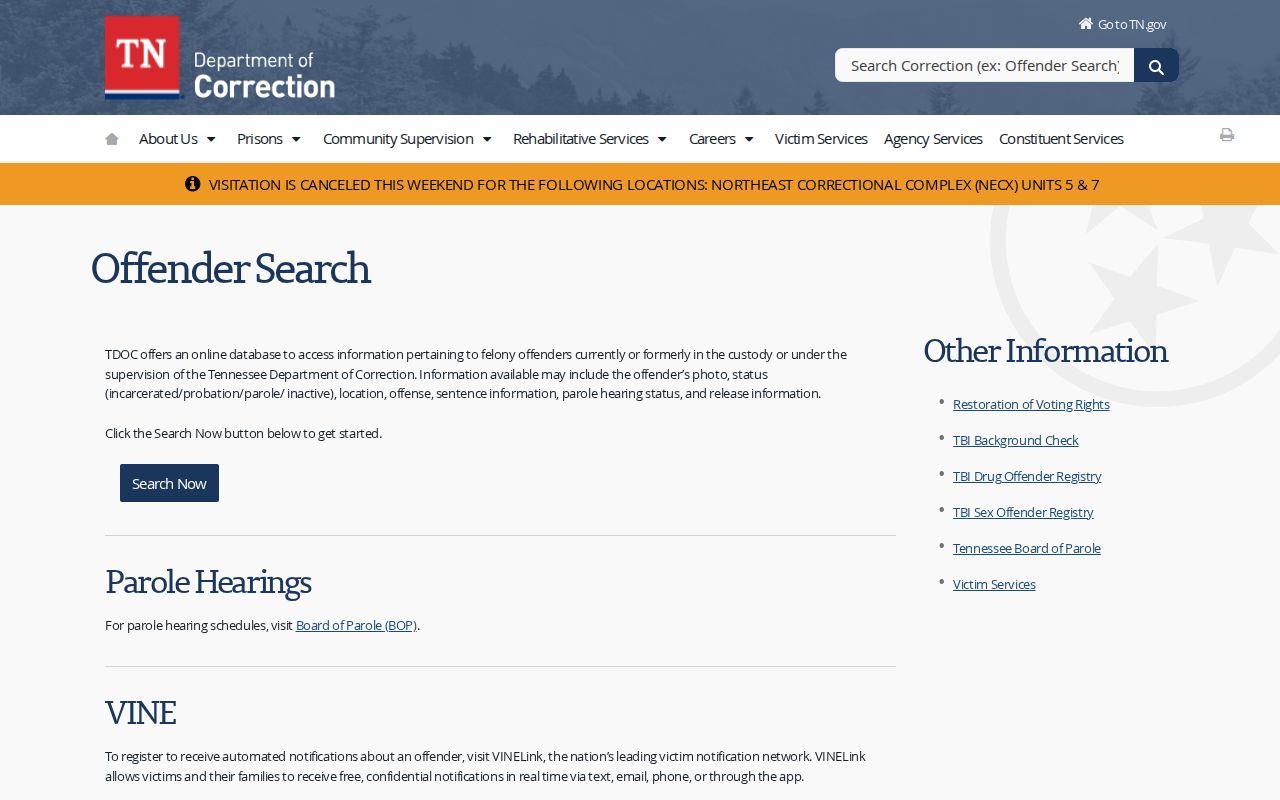
The gateway confirms current and former felony-offender coverage and points to VINELink and MyTN without turning eligibility into a guaranteed release date.
Note: Preserve the date label, source, and observation date because eligibility, expiration, projection, and actual release answer different questions.