
Sequatchie County VINE Coverage
Tennessee uses two reporting layers on the same public platform. TN SAVIN, short for Tennessee Statewide Automated Victim Information and Notification, receives county-jail events. The Tennessee Sheriffs' Association says all 95 county sheriffs take part. Sequatchie County Justice Center events can therefore support a name or booking-number check and alerts for release, transfer, or escape. The service is free and available around the clock. Telephone access is also available at 1-888-868-4631, with TTY service at 1-866-847-1298.
The second layer comes from the Tennessee Department of Correction. TDOC joined VINE for state correctional custody in 2021. That feed can report state custody changes, case information, and release events. It complements FOIL and official written notices. The distinction matters in Sequatchie County. A person can leave the Justice Center through commitment to TDOC. TN SAVIN may report the county event, while TDOC VINE later reports the state event. The first event is a transfer, not proof of community release.
The official TDOC VINE announcement documents the state-prison layer.
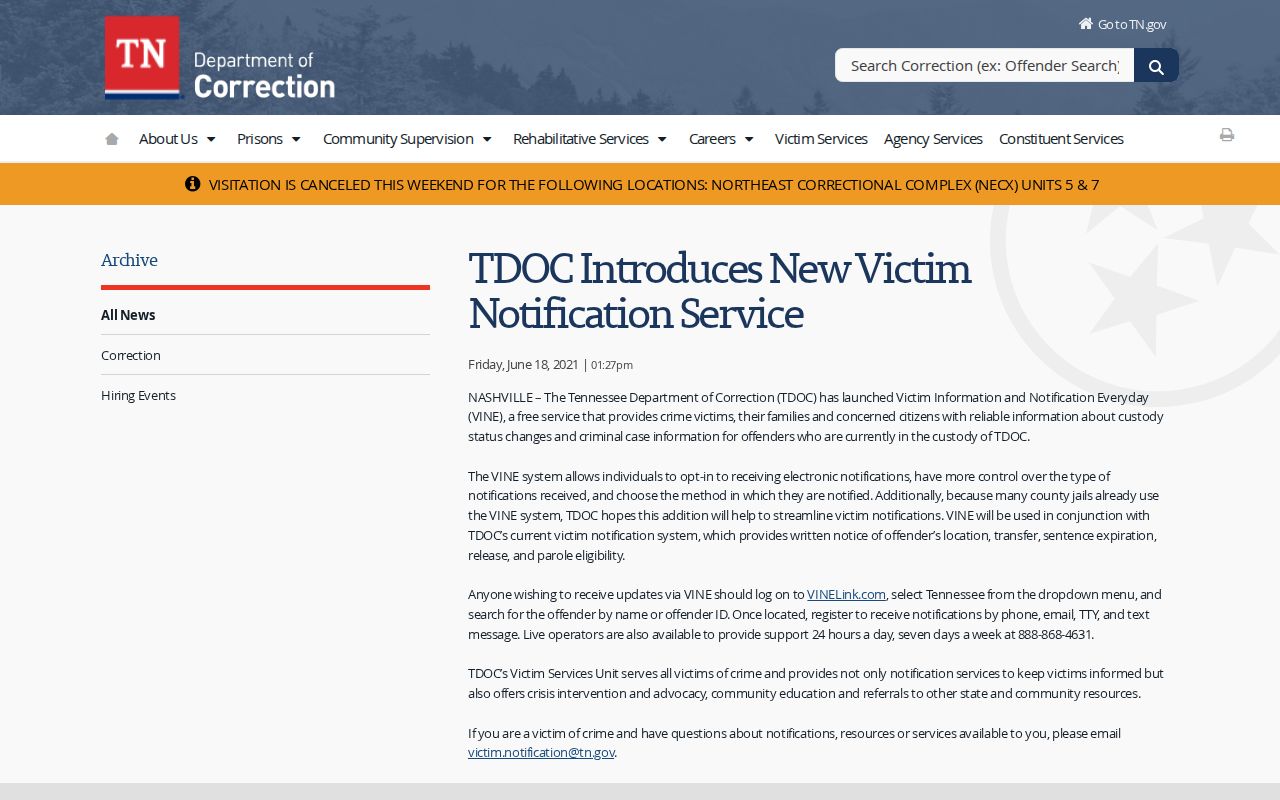
The captured announcement confirms TDOC custody-event coverage without turning VINE into a historical county release archive.
The VINELink portal should be treated as a live notification and status tool. It is not a historical release ledger. If an exact date, time, type, authority, or transfer destination is needed, request the existing booking and release record from the agency that reported the event.
Search One Sequatchie County Inmate
Begin with one identified person, not a broad list. A full name may work, but the offender or booking number is a stronger match. For a Justice Center booking, obtain that number from the jail if possible. For a state case, a TOMIS or TDOC number helps distinguish people with similar names. The reporting facility and agency must also fit the known custody path.
- Open VINELink or call the service and choose Tennessee.
- Enter the full name or the known offender or booking number.
- Compare the returned ID, facility, contributing agency, and identity details.
- Open the correct record and read the exact custody status and latest event.
- Record the displayed wording, source agency, and date it was observed.
- If no match appears, check spelling and identifiers, then call VINE or the Justice Center.
- Request the underlying release record when documentary proof is needed.
Multiple matches require care. Do not choose a record merely because the county or first name looks familiar. Match the ID and contributing agency. A current TDOC record may have a prison or community-supervision location, while a county entry relates to the Justice Center event. The broader Sequatchie County released inmate search explains how the jail record, court order, FOIL, and federal systems answer different questions.
Note: A missing VINELink result can reflect spelling, timing, transfer, or record handling and does not prove release.
Sequatchie County VINE Release Fields
Read the result as a report from the contributing agency. A released or out-of-custody label supports only that the agency reported that custody event. A transfer label means custody moved. Neither outcome proves dismissal, sentence expiration, freedom from another jurisdiction, or the end of post-release supervision. Exact labels can change, so preserve the live wording instead of replacing it with a guess.
| Field or event | What it establishes |
|---|---|
| Name and offender number | The identity used to match the record. |
| Contributing agency | Which jail or correctional agency supplied the event. |
| Facility or location | The reporting custody location, not always the legal end point. |
| Custody status | The agency's status at the time shown. |
| Release event | That the reporting agency recorded release, subject to confirmation. |
| Transfer event | That custody changed hands rather than ending. |
A Sequatchie County VINE result may be the first notice that the Justice Center booking changed. The operational record remains the stronger source for release time and disposition. A local court order can then explain whether bond, dismissal, a sentence, probation, or another legal event authorized the change.
The TDOC FOIL overview shows why state results need separate reading. FOIL may display status, location, sentence details, parole-hearing status, and release information for current or former Tennessee felony offenders. It is not a county-jail roster, and an inactive label is not a universal synonym for successful discharge.
Register Sequatchie County Release Alerts
Registration works best before an expected event. Open the correct matched record first. Tennessee materials describe phone, email, text, TTY, and available app channels. The choices displayed for a particular record control. Keep the four-digit PIN because it confirms automated calls and can stop repeat calls after the notice is heard.
- Open the matched offender and choose the registration or notification function.
- Select an available phone, email, text, TTY, or app method.
- Enter the contact details and confirm them with care.
- Create and save a four-digit PIN.
- Finish the on-screen confirmation so the registration becomes active.
- For a phone alert, listen and enter the PIN when prompted.
- Update the registration after any contact change, then verify each alert with its source agency.
Release, transfer, and escape are different events even though all can trigger notice. Write down the event type and contributing agency. If the PIN is lost, call TN SAVIN. Confidential and anonymous registration protects the subscriber's contact choice, but the state brochure still warns against relying on a notice alone.
Two Tennessee VINE Layers
Sequatchie County has a distinctive two-step verification path. County TN SAVIN covers the Justice Center layer, while TDOC VINE covers the later state correctional layer. A person committed from Dunlap may create events in both. Searchers should follow the agency name rather than treating all alerts as one uninterrupted record.
The local fallback is unusually clear. Sequatchie E-911 contact routing directs inmate inquiries to option 1 at the Justice Center number. Call that route after a county alert and ask whether the named booking ended through community release or transfer. If TDOC became the custodian, use the state record next. This separate Section 19 angle prevents a transfer from being mislabeled as release.
The two-layer model also explains a delayed match. County data and state data originate from different systems. A new TDOC record may not appear at the same moment the county event is received. Preserve each timestamp and confirm the change with the office that created it.
Confirm Sequatchie County VINE Events
VINELink does not replace the records held by Sequatchie County, TDOC, the court, the Bureau of Prisons, or ICE. It also does not provide a complete old-release archive. A county result can lag or disappear. A state result concerns TDOC. Federal sentenced inmates are searched in the BOP locator, while many federal pretrial detainees are in US Marshals legal custody and may not appear as BOP inmates. ICE uses its own locator.
For a local event, call the Sequatchie County Justice Center at (423) 949-7750 and choose option 1. Ask about the named booking. For a state event, compare the VINE notice with FOIL and request TDOC records when the closing event is unclear. If the event says transfer, identify the receiving agency before using release language.
A released person usually drops from a live jail roster because that roster serves current custody. Here, no official Sequatchie roster or release archive is published on the under-construction sheriff domain. That absence is expected. It cannot confirm freedom. The jail release record, the controlling court order, and the receiving system provide the durable path.
TN SAVIN is also distinct from the TBI Sex Offender Registry. The registry applies only to people required to register and may show a photo, registry status, address, reporting date, and registering agency. Its inclusion control can distinguish incarcerated records, but registry presence does not supply a general release date. Most released people will not appear there. Use that system only when the specific person is legally covered, and keep the VINE event tied to the agency that sent it.
Federal custody requires a separate identity and event check. The Bureau of Prisons locator covers federal inmates from 1982 forward and can show a past Release Date with no facility, or a result described as Released or Not in BOP Custody. That proves only the end of BOP custody. A person can remain under federal supervision or enter another system. Many federal pretrial prisoners are held under US Marshals legal custody, sometimes in a local jail, and do not fit the sentenced-inmate BOP path. VINELink should never be presented as their locator.
ICE uses its own Online Detainee Locator System. Its search requires either an A-number with country of birth or exact name, date of birth, and country of birth. ICE says the system can include some people released from its custody during the prior 60 days, but exclusions, exact spelling, and data lag limit a no-result. A transfer from the Sequatchie County Justice Center to ICE is not community release. Confirm the county event first, then read the federal result only for the custody layer it covers.
Note: A VINE event belongs to one contributing agency, so check other custodians before concluding that all custody ended.